About Me

My photo
Welcome to nc’s blog. Read, comment, interact, engage. Let’s learn together - recursively.
Showing posts sorted by relevance for query civility. Sort by date Show all posts

Tuesday, December 17, 2013

Civility

At the school I currently serve (Guthrie CSD, Guthrie, Texas), we are teaching our children ways of thinking and ways of behaving that go beyond academic content.  We call this framework of learning the Guthrie Graduate Profile.  We believe that students who learn these future-ready skills stand the best chance of living happy, fulfilling, and productive lives. 

Civility is not a word that shows up in the Guthrie Graduate Profile, but its essence is clearly present.  When we learn to treat others with respect, courtesy, and empathy - with civility - we open the door to understanding the “other” better, and to being better received by the “other.”

Unfortunately, the entertainment effect derived from conflict, put-downs, and disparagement (as demonstrated by a whole host of politicians and entertainers) makes our work along these lines that much more difficult.  We too often feel we're swimming against the cultural tide.

When we treat others with respect, we gain 
(not always what or as much as we want, but something).

When we treat others disrespectfully, we always lose 
(usually in ways that we can’t imagine or measure).

Here is a critical point we try to reinforce with our students:
With so much to gain and so little to lose, treating others respectfully will ALWAYS work to their benefit.


(By the way, it works for us big people, too).

Wednesday, September 24, 2014

HonorableService

I was blessed to have been able to present Texas Senator Robert Duncan with a commemorative artifact this week, in a reception held in his honor.   Senator Duncan is retiring from the Texas Senate, after 21 years of service.  His new title is that of Chancellor of Texas Tech University.

Among the presenters who spoke at that event, four big ideas stuck in my mind as Senator Duncan's work as a public servant was recognized.  Here they are:

  1. He always brought civility to the table, even when dealing with contentious and partisan issues.  What a tribute!  I have written about Civility before, but it's a topic that gets short shrift in both text and deployment. 
  2. He always offered a solution, even when it was politically perilous. Rather than work and campaign on the "I'm agin' it" platform, he listened, sifted, synthesized, and forged workable solutions that could pass the this-is-good-for-us-all test.  Not seeing a lot of that kind of statesmanship these days.
  3. He constantly worked calmly and reasonably, with folks of both parties, to create consensus around important policy decisions.  Hmmmm...  Now I'm wishing he would run for national office.
  4. He leaves a "legacy of love" (to quote Charles Perry, the man who has won the seat Duncan vacated).  That is not a phrase often attached to those who have spent decades in political positions.  Wouldn't mind having that one tattooed on my own headstone.
Senator Duncan is genuinely a "good guy," and I'm betting he'll be missed by a LOT of folks in Austin (on both sides of the political aisle).   Texas Tech knocked it out of the park when they got him.

But the point of this blog is not so much to honor Senator/Chancellor Duncan as it is to point to the attributes he embodies that I believe we should look for in ALL our leaders (regardless of party, regardless of role).  

Perhaps the science of cloning offers some hope on this front.


Sunday, June 25, 2023

CivilityWins

Sarcasm generates giggles. Tackiness scores laughs. Insults get chuckles. Condescension delights. Disrespectful snipes entertain. Mockery amuses. Ridicule gets likes.

Almost always are those effects short lived, among the watchers. 

Almost never are those efforts forgotten, by the targets.

Civility and respectfulness come with their own rewards. 

And, generally, those rewards compound over time.


Sunday, April 27, 2014

JB'sPassing

The circle/cycle of life has taken another of my mentors this week.  Jimmy Bickley, the school superintendent that both Moe (my lovely bride of 37 years) and I broke into the profession under, passed away the other day.  In fact, we had the great good fortune to have worked for/with Mr. Bickley on two different occasions.

Some of the powerful lessons of life and leadership I learned from Mr. Bickley:

  • Faith - Understanding God is a lifelong process that is never completed, but we should never presume to know the mind of God.
  • Unflappability - Steadiness under fire from leaders is a hallmark of the best ones.
  • Stewardship - Wanting resources and needing resources are two different things; leaders should be able to tell the difference and exhaustively try to provide for the latter.
  • Family - Devotion to family is a sure indicator of the depth of our character.
  • Affirmation - Support and recognition for those who are "doing the work" on the front lines of an organization is worth its weight in gold.
  • Kindness - Even in the heat of battle/argument/debate, civility and courtesy must prevail (warranted or not).
  • Humor - See, and help others see, the humor that underlies almost every human endeavor; life is too painful otherwise.
RIP, Jimmy Bickley.  A legion of educators (and the students they serve) are better for having known you and served with you. 

Friday, November 4, 2022

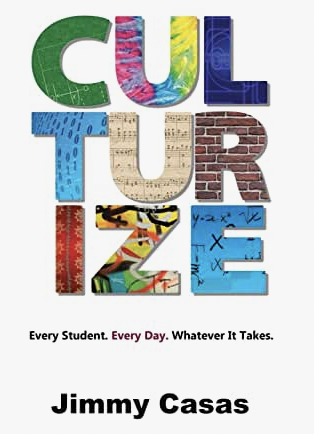
Culturize

I recently read Culturize: Every Student. Every Day. Whatever It Takes by Jimmy Casas (2017).


JS speaks to strategies that school leaders can enact to positively impact student learning outcomes, along numerous dimensions. He focuses a great deal of the book on concrete moves leaders can make.

My biggest takeaways:

·       A conversation is not just words flying – it’s body language, smiles, eyes, pacing and pausing…

·       Definition of Culturize: To cultivate a community of learners by behaving in a kind, caring, honest, and compassionate manner in order to challenge and inspire each member of the school community to become more than they ever thought possible.

·       Fairness necessarily means treating others differently.

·       Providing clarity lowers anxiety.

·       Power and rightness are not the same thing.

·       Tricky conversations are best had in person.

·       There is no excuse for not contacting the parent of a failing student.

·       Leaders own their morale.

·       Awfulizing is the habit of verbally bashing others, circumstances, decisions. 

·       Awfulizing = unwelcoming, rude, critical, provoking, cruel. 

·       Awesomizing = inviting, civility, accepting, deterring, compassionate.

·       Great change begins with self-change.


My favorite quotes:

“To often, however, we get stuck in the habit of simply managing a mediocre culture.” (p. 9)


“Your culture of your organization will be defined by the worst behavior you are willing to tolerate.” – Todd Whitaker & Steve Gruenert (School Culture Rewired). (p. 97)


A very nice read in relation to leadership moves dedicated to improving organizational culture. 

Thursday, February 6, 2020

AlienatedAmerica


I recently read Alienated America: Why Some Places Thrive While Others Collapse by Timothy Carney (2019). 


In this book, TC dissects voting trends in both the primary and general elections of 2016 to try to make sense of why large collections of American voters felt/feel disenfranchised.  TC not only carefully disaggregated the numbers via statistical analysis, he also followed up with qualitative interviews/observations to delve more deeply into the causes and effects of political, social, and economic disparity. 

Some of my biggest takeaways:

Ø  Ease of mobility in America has had the effect of creating pockets of self-segregated “elites” (affluent and/or educated) from the “non-elites,” resulting in the polarization of worldviews. Those are not “merely differences of income, wealth, or education; they are differences of health, hope, and opportunity.” (p. 62)
Ø  When people are afflicted with “idleness” – nothing to do – traditional social institutions begin to collapse.
Ø  To truly understand others we must engage them where they are – in their communities.  Simply crunching data sets does not effectively tell the whole story.
Ø  Trust is a requirement of healthy community; it allows us to lower our defense shields.
Ø  The dissolution of family and houses of faith are at the root of America’s social and economic problems.
Ø  Loss of civility is directly proportional to the collapse of traditional social institutions (e.g., family, church, book clubs, bowling leagues, service organizations, etc.)
Ø  Secularization is the effort to force religion into being solely a private experience, depriving it of the self-actualizing effects of service for the greater good of the community.
Ø   A continuum:  Total regulation & low trust  <--->  Low regulation & high trust.  (Community health is low on the left end and high on the right end.)
Ø  Family strength is a powerful predictor of the potential for upward mobility for children.

My favorite quotes:
“Strong communities function not only as safety nets and sources of knowledge and wisdom, but also as the grounds on which people can exercise their social and political muscles. These are where we find our purpose.”  (p. 12) 

“Bad economics can help kill a community, but good economics cannot, alone, rebuild one. And if you’re not building community, you’re not getting close to fixing what ails us.” (p. 282) 

A very insightful examination of our national “health.”  Thanks for the recommendation, TM.